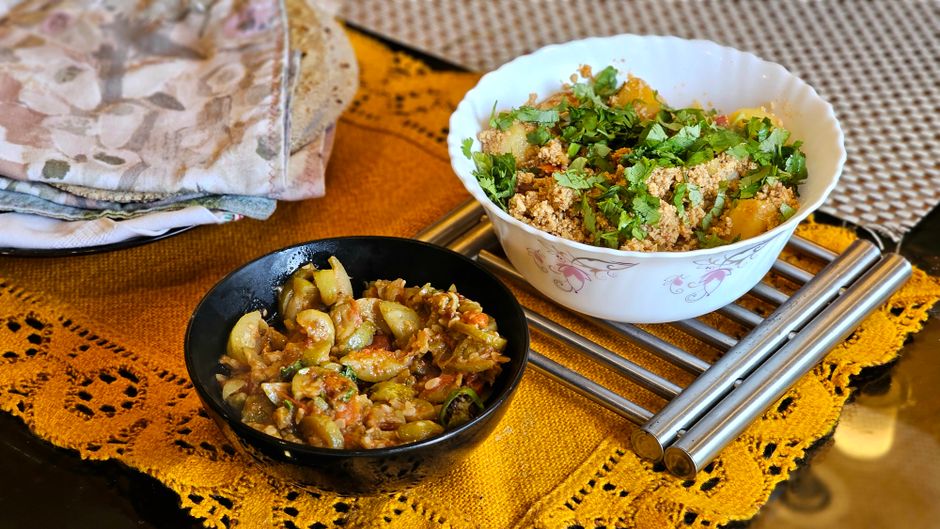
Undhiyu
ઉંધિયું
Undhiyu is the crown jewel of Gujarati winter cooking — a gloriously complex, slow-cooked dish of seasonal vegetables, raw banana, purple yam, and baby eggplant, all stuffed individually with a spiced green paste and then layered in a pot with methi muthia (fried fenugreek dumplings), ground peanuts, and fresh coconut, then cooked on a low flame with almost no water. The name comes from the Gujarati word 'undhu,' meaning upside down — traditionally, the clay pot was sealed with dough and buried under hot coals with the mouth facing down, trapping all the steam inside. The vegetable list is non-negotiable: surti papdi (flat green beans), raw banana, purple yam (kand), small eggplants, sweet potato, and methi muthia are the core. The stuffing — a paste of fresh coconut, coriander, ginger, garlic, green chilli, sesame seeds, lemon, and spices — is what turns individual vegetables into a unified, layered dish where every component absorbs every other. This is festival food, made once a year in the peak of winter when surti papdi is in season, and families gather to eat it with puri.
- Total
- 1 hr 20 min
- Serves
- 5
- Level
- Hard
Prep 40 min · Cook 40 min
Ingredients
Method
Make the stuffing paste first: blend together the fresh coconut, coriander, garlic, ginger, green chillies, sesame seeds, coriander powder, cumin powder, turmeric, sugar, lemon juice, and 1 teaspoon of salt into a coarse, fragrant green paste — it should hold together when pressed but not be completely smooth. You want texture. Taste it: it should be punchy, herby, sweet, sour, and spiced all at once. This same paste will stuff the eggplants, coat the papdi, and layer through the entire pot. Divide the paste into thirds roughly in your mind — one third for stuffing vegetables, two thirds for layering.
About 12 min
Prepare the vegetables. Make a deep cross-cut in the base of each baby eggplant (from the bottom, not the stalk end) and press a generous teaspoon of stuffing paste deep inside each one. String the surti papdi and toss them with a third of the stuffing paste, coating each bean well. Toss the raw banana chunks and purple yam chunks with a light sprinkle of turmeric and salt separately — they don't get stuffed, but will absorb the paste from the layering. Keep each vegetable separate — they have different cooking times and must be layered strategically.
About 15 min
Heat the oil in a wide, heavy-bottomed pot (a Dutch oven or deep kadai works well) over medium heat. Lightly fry the methi muthia in the oil for 2–3 minutes, turning until they develop a golden crust. Remove and set aside — they'll finish cooking in the steam. Now add the stuffed eggplants to the same pot and cook for 3–4 minutes until they begin to colour on the outside. Remove and set aside. You're building flavour in the pot with each vegetable.
About 10 min
Layer the pot: start with the sweet potato and purple yam on the bottom (they need the most cooking time). Spread a third of the remaining stuffing paste over them. Add the raw banana and surti papdi in the next layer. Nestle the stuffed eggplants on top. Scatter the methi muthia over everything. Spread the final third of the stuffing paste over the top layer, then scatter the ground peanuts over the entire surface. Add 3 tablespoons of water down the sides of the pot — just enough to create initial steam. Drizzle the remaining oil evenly over everything.
About 8 min
Cover the pot tightly (seal the lid with a wet cloth or dough rope if you want to be traditional) and cook on the lowest possible heat for 35–40 minutes. Do not open the lid for the first 25 minutes — all the cooking happens in trapped steam and the vegetables release their own moisture. After 30 minutes, carefully lift the lid and check: a skewer should pass through the sweet potato and yam without resistance, and the eggplants should be completely collapsed and silky. If the bottom layer looks dry, add 2 more tablespoons of water and cook another 10 minutes. Serve hot from the pot alongside puris, with fresh green chutney and a spoonful of ghee for non-vegans.
About 40 min
Nutrition per serving (estimate)
- Calories
- 410
- Protein
- 11 g
- Carbs
- 52 g
- Fat
- 17 g
- Fibre
- 12 g
- Sugar
- 9 g
- Sodium
- 600 mg
Contains: peanuts, sesame
You might also cook
All Indian recipes 45 min
 Hotel Style Sambar
Indian · Medium
 55 min
 Punjabi Chana Masala (Spiced Chickpea Curry)
Indian · Medium
 50 min
 Rajma Chawal
Indian · Easy
 30 min
 Schezwan Fried Rice
Indian · Easy
 1 hr
1 hr Pindi Chole (Rawalpindi-Style Black Chickpea Curry)
Indian · Medium
 35 min
 Aloo Gobi (Punjabi Dry Potato and Cauliflower Sabzi)
Indian · Easy
Recipe by Boon Tools.