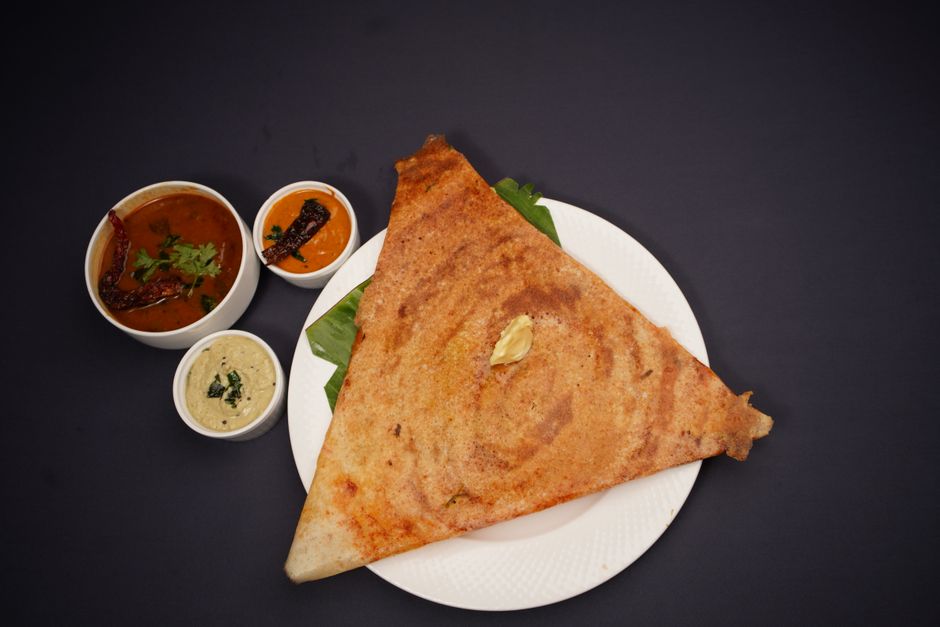
Pesarattu
పెసరట్టు
Andhra Pradesh's iconic breakfast crepe — vibrantly green, delightfully crispy at the edges, and packed with the earthy protein of whole green moong. Unlike a dosa, pesarattu needs no fermentation and no fuss: soak the lentils overnight, grind them with fresh ginger, green chilli, cumin, and a handful of rice for crispiness, and spread the batter thin on a scorching griddle. Finely chopped onion and ginger are pressed into the surface while it cooks, adding sweetness and crunch to every bite. Served with the fiery, deeply aromatic allam pachadi (Andhra ginger chutney), this is one of South India's most satisfying and nourishing breakfasts. The famous 'MLA Pesarattu' version — named after the politicians who ordered it at Vijayawada restaurants — stuffs the whole crepe with a mound of upma.
- Total
- 40 min
- Serves
- 4
- Level
- Easy
Prep 20 min · Cook 20 min
Ingredients
Method
The night before (or at least 6 hours ahead): combine the whole green moong and raw rice in a large bowl and cover generously with cold water — they will swell considerably. Soak for a minimum of 6 hours, ideally overnight. When ready, the moong skins will have softened and a few may have split open, and the rice grains will feel slightly tender between your fingers. Drain and rinse well. This long soak is non-negotiable: it's what makes the batter grind smoothly and gives the crepe its characteristic bite.
About 5 min
Transfer the drained moong and rice to a blender. Add the roughly chopped ginger, green chillies, cumin seeds, salt, and about 200 ml of cold water. Blend until you have a smooth, thick, pourable batter — slightly coarser than a dosa batter is fine and gives the pesarattu a more textured, rustic feel. The batter should be vibrantly green from the moong skins. Taste it: it should be well-seasoned with a sharp kick of chilli and ginger. Adjust salt. If the batter feels too thick to spread easily, add water a tablespoon at a time — you want it to flow like a thick pancake batter.
About 8 min
In a small bowl, mix together the finely chopped onion, minced ginger, and chopped cilantro — this is your topping that gets pressed into each pesarattu as it cooks, which is what sets this apart from a plain crepe. Set it right next to the stove. Heat a flat cast-iron griddle or heavy non-stick pan over medium-high heat until a few drops of water flicked onto the surface sizzle and vanish within a second. Rub the surface lightly with a paper towel dipped in oil.
About 3 min
Ladle about 3/4 cup of batter onto the centre of the hot griddle. Working quickly, use the back of the ladle in firm, confident circular strokes to spread it outward into a thin round — aim for about 20–22 cm across. Don't press too hard or the batter tears; keep the motion fluid and continuous until you've spread it as far as it'll go. Scatter a generous tablespoon of the onion-ginger-cilantro topping over the surface and press it gently into the batter with your spatula so it embeds rather than just sitting on top. Drizzle about half a teaspoon of oil around the edges and another few drops across the surface. Cook for 2–3 minutes until the edges turn golden-brown and lacy, and you can see the underside has gone from raw-green to set and slightly golden.
About 10 min
Flip the pesarattu carefully — the cooked side should be a deep, mottled golden-green with lacy, crisped edges. Cook the second side for just 60–90 seconds; it doesn't need as long. Fold in half and slide off the griddle immediately. Unlike dosa, pesarattu is best eaten right off the pan, as it loses its crispiness within a few minutes. Repeat with the remaining batter, re-oiling the griddle between crepes. Serve hot alongside allam pachadi (Andhra ginger-tamarind chutney) and, if you want the full Vijayawada experience, a scoop of fresh upma folded inside for the iconic MLA Pesarattu.
About 10 min
Nutrition per serving (estimate)
- Calories
- 360
- Protein
- 15 g
- Carbs
- 50 g
- Fat
- 10 g
- Fibre
- 10 g
- Sugar
- 3 g
- Sodium
- 490 mg
You might also cook
All Indian recipes


Recipe by Boon Tools.